Energy Fluxes (Vegetation Climate Interactions through Energy Fluxes)
Project aims
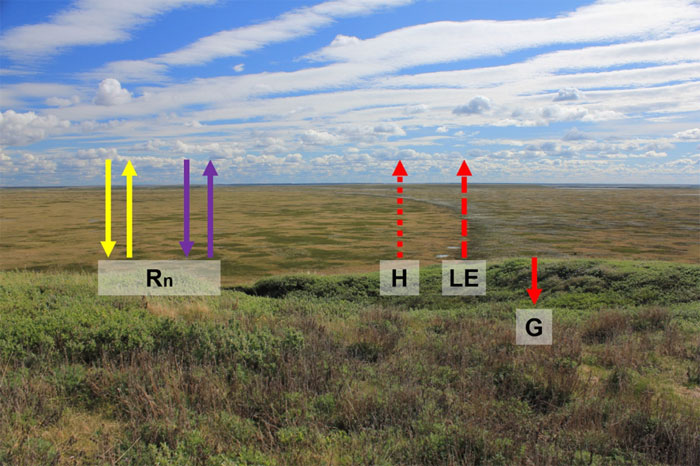
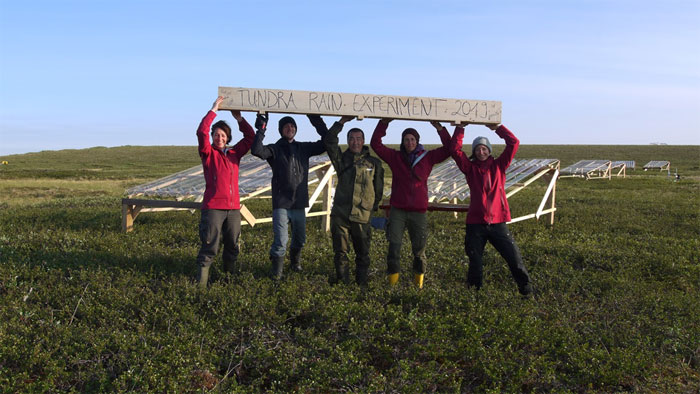
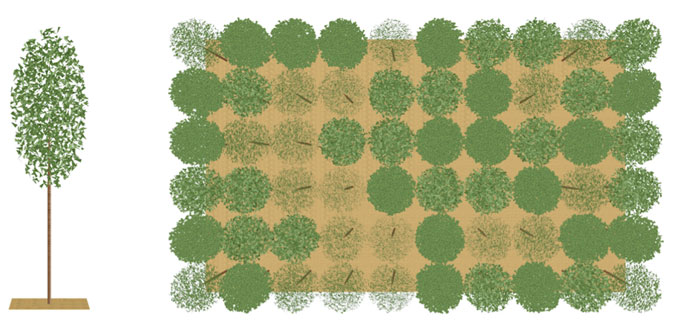
The Arctic is one of Earths’ regions most heavily influenced by climate change. A change in climate also reflects changes to surface energy fluxes, which play a pivotal role in Earth system dynamics (Fig. 1). We want to understand the role of energy fluxes in shaping interactions and feedbacks within the earth system (i.e. carbon cycle, water cycle, permafrost dynamics, biodiversity change, etc.) under current and future climate scenarios. We will address this goal by integrating knowledge from literature, using an experimental approach in the Arctic tundra (cf. TRAIN experiment; Figs. 2 and 3), and using the DART 3D radiative transfer model with in silico plant communities (Fig. 4).

People involved
Elena Plekhanova, Jacqueline Oehri, Raleigh Grysko, Gabriela Schaepman-Strub
Specific projects
- Tundra rain experiment (TRAIN)
- Trait diversity effects on shortwave radiation budget (DART 3D radiative transfer model)
- Status and drivers of the Arctic tundra energy budget (literature review)
Relates Publications
- Juszak I., Iturrate-Garcia M., Gastellu-Etchegorry JP., Schaepman ME., Maximov TC., Schaepman-Strub G. (2017). Drivers of shortwave radiation fluxes in Arctic tundra across scales. Remote Sensing of Environment, 193, 86-102. DOI: 10.1016/j.rse.2017.02.017
- Juszak I., Eugster W., Heijmans MMPD., Schaepman-Strub G. (2016). Contrasting radiation and soil heat fluxes in Arctic shrub and wet sedge tundra. Biogeosciences, 13, 4049-4064. DOI: 10.5194/bg-13-4049-2016