PhD Program in Ecology
Completing a PhD research project in the joint University of Zurich (UZH) and Swiss Federal Institute of Technology (ETH) Zurich, PhD Program in Ecology, in one of the internationally acclaimed research groups, enhances a student’s PhD experience. Students of this program are enrolled at either the UZH or the ETH. The program offers research training in the interdisciplinary field of ecology, general skills training for academic and non-academic excellence, and opportunities to interact with other doctoral students. The program includes a curriculum of at least 12 ECTS credits, teaching experience, and is usually completed within three to four years (full-time). It offers yearly graduate schools, courses on subject specific matters and on methods that are of direct use to the work of doctoral students. Additional courses on transferable skills prepare students for professional life, whether this is in an academic institution or not. Research seminars foster international collaborations and the exchange of experiences among doctoral students and experts from different fields of ecology.
___________________________________________________________________
Featured PhD Project: Fall 2026
Advancing Systematic Conservation Planning Across Ecological Realms
Oluwadamilola Christianah Ogundipe
No ecosystem exists in isolation. Natural processes cross environmental boundaries constantly, and what happens in a terrestrial forest may directly shape the adjacent freshwater stream. Planning for biodiversity across realms simultaneously is ecologically necessary but remains rare in practice because coordinating across fundamentally different environments is more complex than it appears.
The challenge is as much geometric and socioeconomic as ecological. When we jointly optimize for terrestrial, aquatic and amphibian species within a single model, asymmetric geometries compete directly. Narrow, linear river networks occupy a small spatial extent relative to the surrounding landscape, making them easy to overlook in standard planning models unless explicitly accounted for. In human-dominated landscapes, the challenge runs deeper still, as conservation implementation must also contend with intense land-use friction.
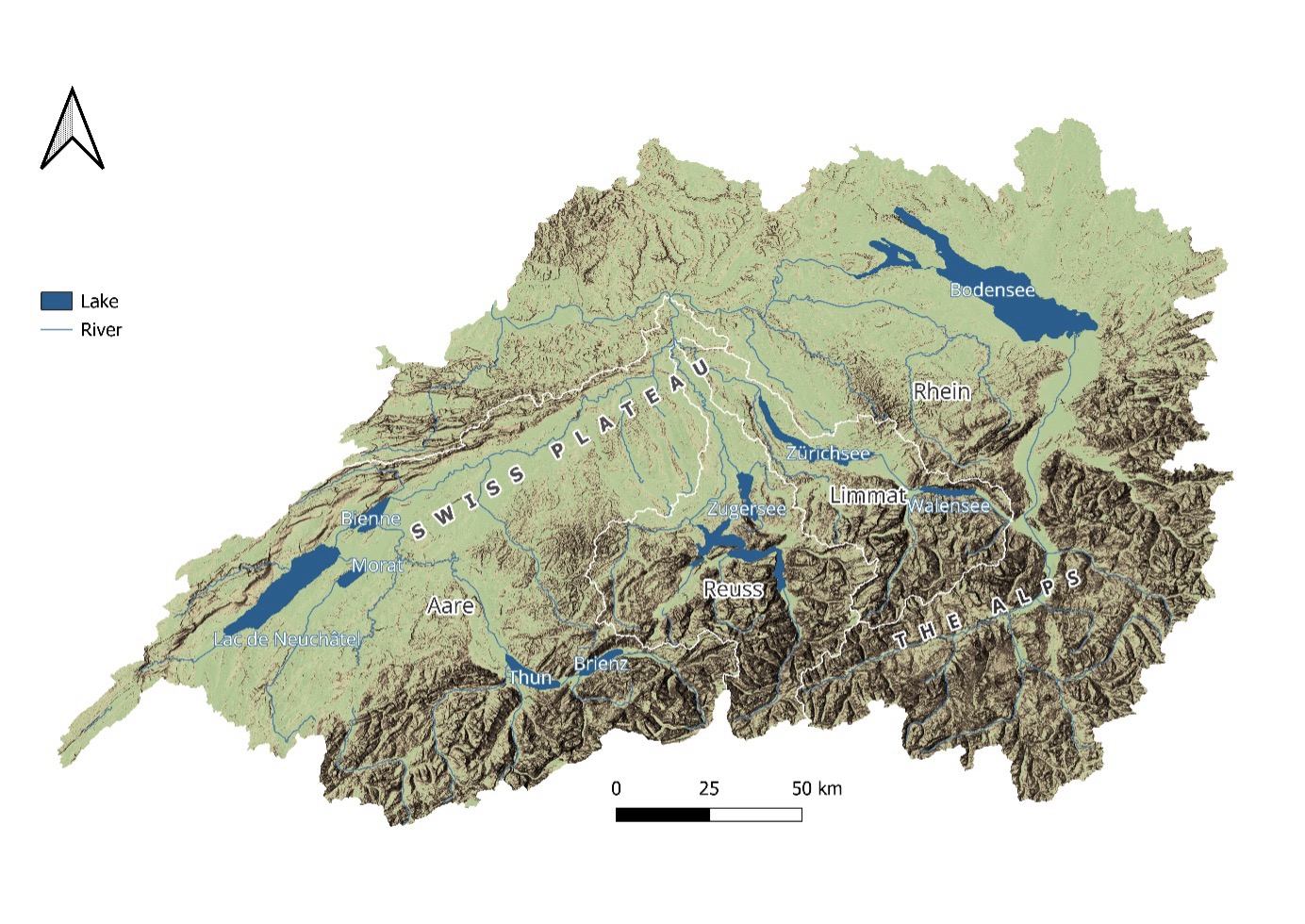
My work addresses this through a cross-realm planning framework for the Aare-Rhine catchment. Incorporating species data across terrestrial, freshwater and amphibian groups alongside a spatially variable land-use cost layer, I show how ecological representation can be achieved without ignoring implementation feasibility. The results suggest that how we configure a plan may matter as much as how much land we designate.
___________________________________________________________________
Photography for Scientists
Science and science communication rely heavily and extensively on photography. In this course organised by the PhD Program in Ecology, student scientists were taught how to be more "visually literate", empowering them to more effectively communicate their science.
Filmmaking for Scientists
In this course organised by the PhD Program in Ecology, students learnt how to prepare their own documentary films, including how to deal with camera and lighting, screenwriting/storyboard and film editing. At the end of the workshop, the PhD students prepared a short documentary film.